BlogProduct
ProductDevplan
AI product management: what it is and how it works
AI product management lets AI do the groundwork of product work: ranking requests, writing specs from your code, estimating and tracking. How it works.
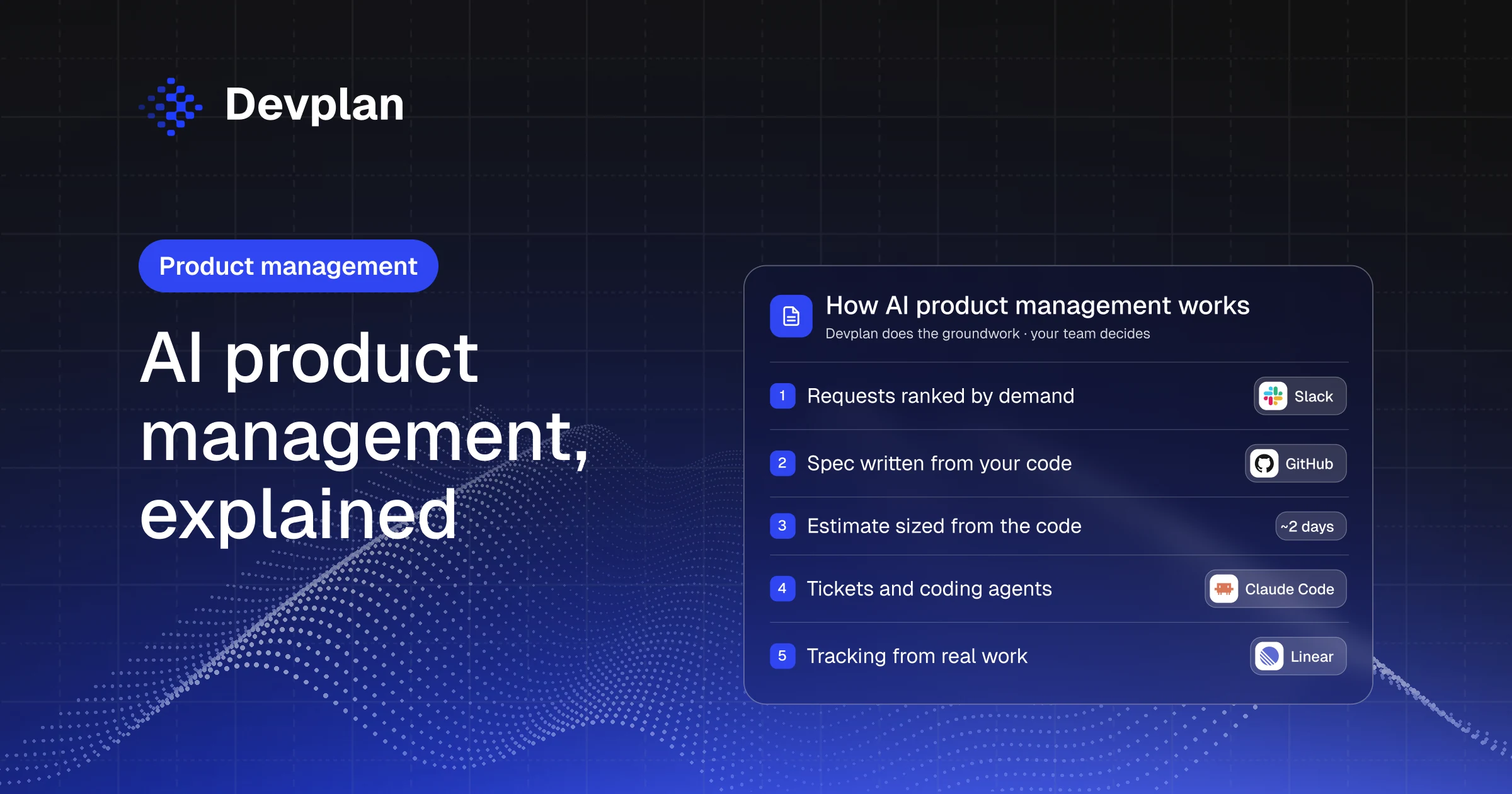
Short answer: AI product management is product management where AI does the groundwork. It collects customer requests from calls, tickets and Slack, ranks them by demand, writes specs from your code, estimates the work and tracks it, while the product manager decides what gets built. Devplan is AI-native product management software for software teams that does this across the tools you already use.
A note before we start. We build Devplan, so this article explains the idea through the way Devplan works. The steps apply to any software team, and the examples follow one example project: a CSV export.
What is AI product management?
AI product management is the practice of letting AI handle the evidence gathering and admin of product work, so product managers spend their time on decisions. The AI finds what customers ask for, writes specs grounded in the code, sizes the work and keeps status current from the work itself. Devplan, an AI product manager for software teams, does this from your calls, tickets, Slack and code.
The same phrase also names a different job: managing products that are built on AI, such as features powered by large language models. Most AI product management courses and job listings mean that second sense.
| AI that does product management | Managing AI products | |
|---|---|---|
| What it means | AI handles the groundwork of product management for any software product | A product manager role for products built on machine learning or language models |
| What it changes | How a team decides what to build and how it tracks the work | What the team builds, and how it tests model behavior |
| Where Devplan fits | This is what Devplan does | Not the focus of this article |
How AI product management works
The work moves through six steps, from the first customer request to the feature in production. People make the calls at the steps marked in the diagram, and the AI does the rest.
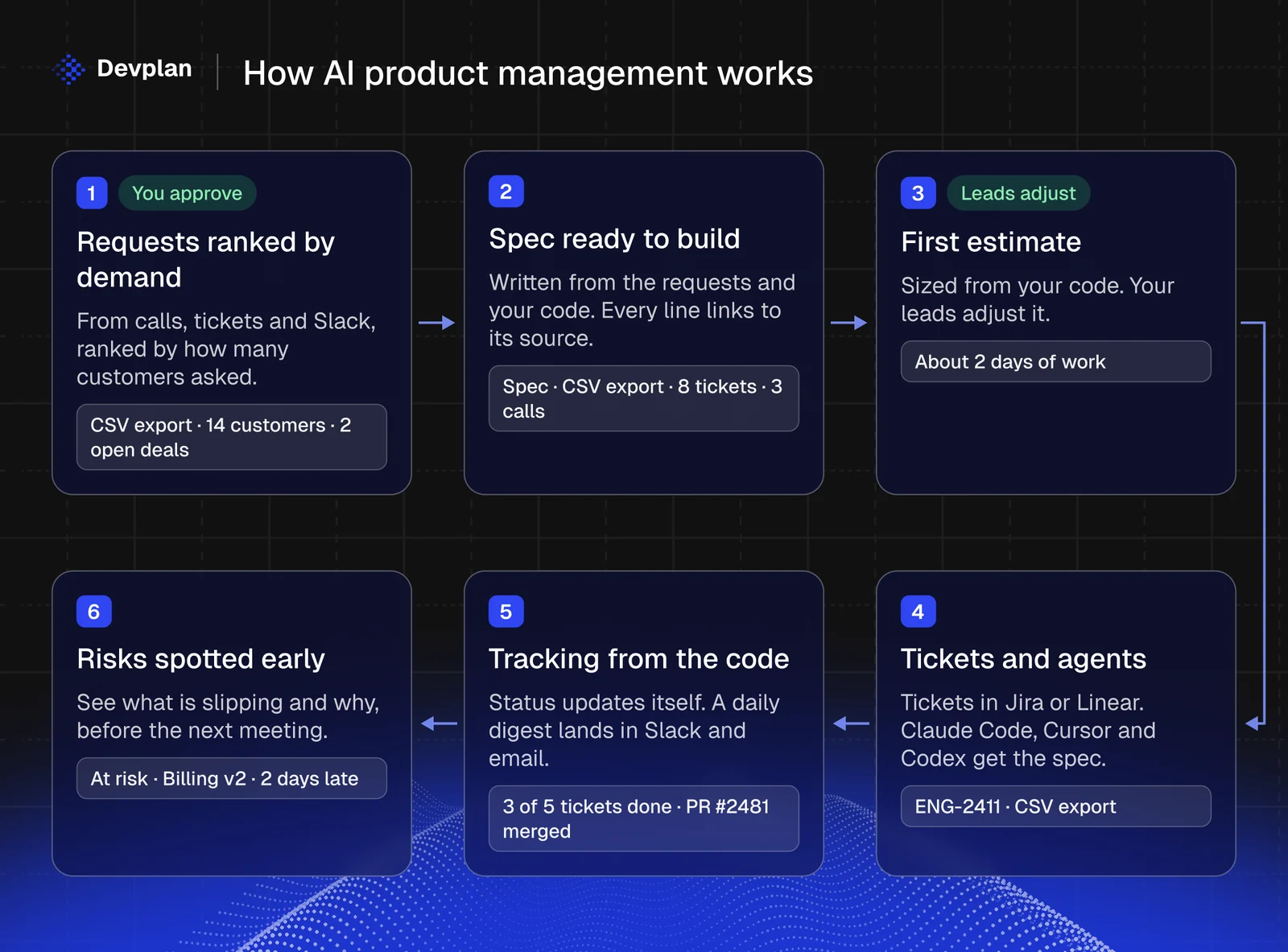
- Requests are ranked by demand. The AI picks up requests from calls, tickets and Slack, groups the duplicates and ranks them by how many customers asked and the revenue behind them. You approve what gets built.
- A spec is written from the requests and the code. Every line of the spec links to the call, ticket or file it came from, so you edit a draft instead of starting from a blank page.
- The work gets a first estimate. The estimate is sized from your code, and your engineering leads adjust it.
- Tickets and coding agents get the spec. Specs become tickets in Jira or Linear, and coding agents such as Claude Code, Cursor and Codex get the spec and the reasons behind it.
- Tracking comes from the code. Status updates itself as the work moves, and a daily digest lands in Slack and email.
- Risks show up early. You see what's slipping and why before the next status meeting.
Steps 2 to 4 are spec-driven development with the product work built in. Our guide to spec-driven development covers that part in depth, and the feedback to feature page shows the whole flow in Devplan.
What stays with the product manager
The PM still decides. AI product management takes the groundwork off their plate, which leaves more time for the parts of the job that need judgment:
- choosing what to build and what to drop
- making trade-offs between customers, effort and strategy
- talking to customers, which no summary replaces
- approving the spec, the estimate and the plan
The AI keeps the evidence, the specs and the status current, and the team makes the calls. For the tools PMs use alongside an AI product manager, read our guide to the best AI tools for product managers.
AI product management vs AI project management
The two get mixed up because the names sound alike and they meet in the same tracker. They answer different questions.
| AI product management | AI project management | |
|---|---|---|
| Main question | What should we build, and why? | When will it be done, and who is doing it? |
| Works from | Customer requests, past decisions and the code | Tasks, schedules, people and status |
| Produces | Ranked projects, specs and estimates | Plans, schedules, status reports and risk alerts |
| Typical tools | Devplan, plus assistants such as Claude for writing | Trackers with AI features, such as Jira, Linear, Asana and monday.com |
Much of AI project management is about the reporting side of the job. In 2019, Gartner predicted that by 2030, 80% of the work of today's project management discipline would be eliminated as AI takes on functions such as data collection, tracking and reporting.
For software teams, the two meet in tracking. When status comes from the code, the product side and the project side read the same picture. Devplan works with Jira and Linear, or on its own. If you're comparing trackers, our Linear vs Jira comparison goes tool by tool.
Agentic product management
Agentic product management is AI product management where AI agents also take actions. In practice, an agent creates the tickets, hands a spec to a coding agent such as Claude Code or updates a project's status, and a person approves the steps that matter. Devplan works this way: it drafts and files the work, and your team approves what gets built.
Where AI product management shows up
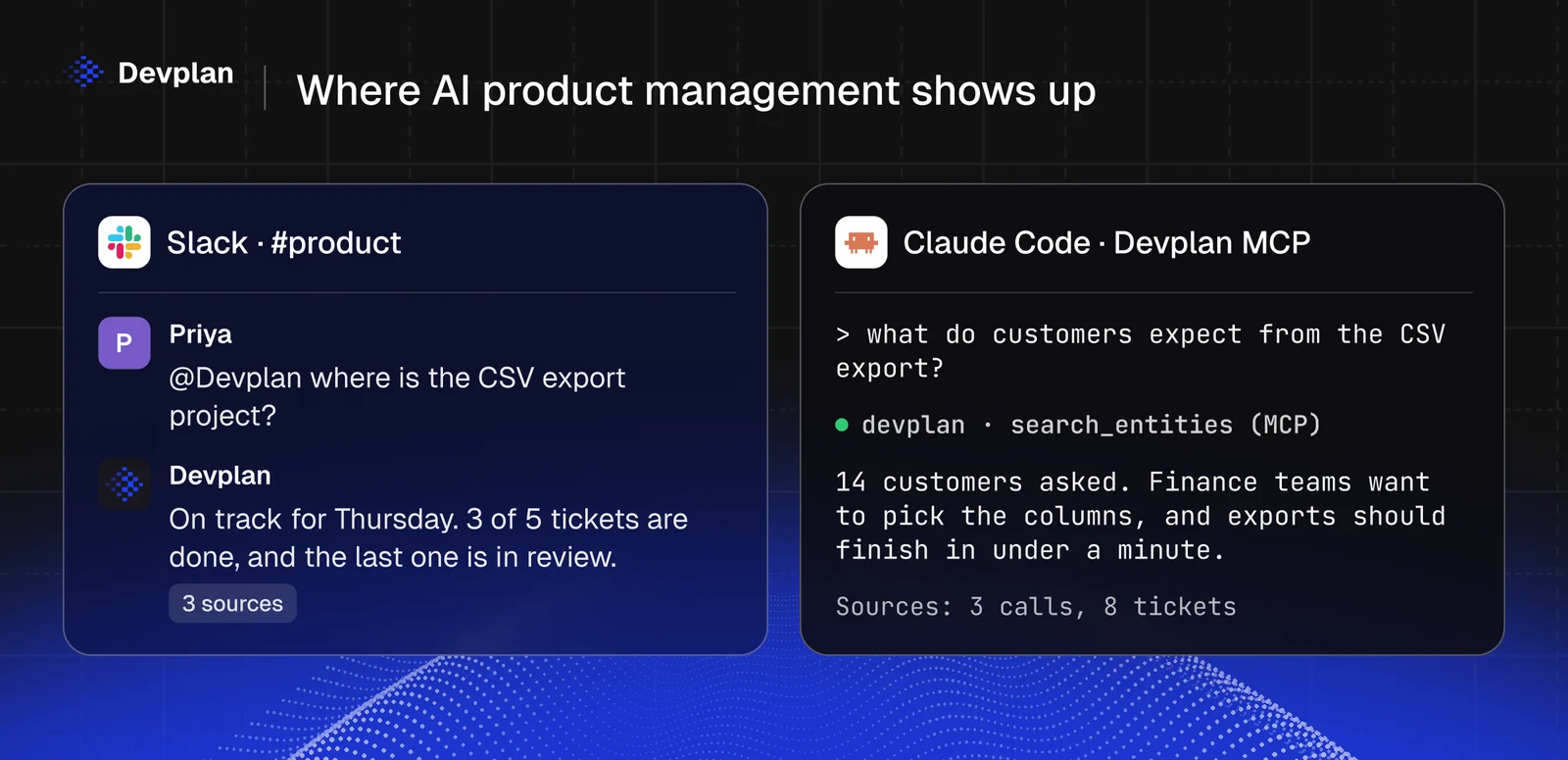
AI product management works best in the places a team already works, so Devplan shows up in two of them.
In Slack, anyone can ask Devplan where a project stands or what customers asked for, and every answer comes with its sources. In Claude Code, engineers get the same product context through Devplan's MCP server, so the coding agent knows what customers expect before it writes code. Both answers come from the same product brain, which links customer requests, decisions and code.
Frequently asked questions
What does AI mean in project management?
AI in project management means software that does the data collection, tracking and reporting a project manager used to do by hand, and helps with planning and risk. For software teams, Devplan does this from the work itself: status updates as the code moves, and risks show up before the next meeting.
Will project managers be phased out by AI?
The tasks change more than the role. Gartner expects AI to take over most of the data collection, tracking and reporting, while deciding priorities, managing trade-offs and working with people stay with humans. Devplan follows the same split: it keeps status and evidence current, and your team makes the calls.
What does an AI product manager do?
Devplan's AI product manager finds what customers ask for, ranks it, writes specs grounded in your code, estimates the work and tracks it, so the human PM can focus on decisions. The title "AI product manager" also describes a person who manages AI-powered products, which is a different job.
What is agentic product management?
Agentic product management is AI product management where agents also act. Devplan, for example, creates tickets, hands specs to coding agents such as Claude Code and updates status, while people approve what gets built.
Plan your next feature with Devplan
Let the AI do the groundwork. Start free with $100 in credits, no card needed.
About the author. Chris Bee is the co-founder and CEO of Devplan.