Company Context Should Compound
MCP gives every employee access to company information. A shared context layer makes what one person learns useful to everyone else.
Your analytics documentation says a customer is active if they used the product in the last 30 days. A finance document says a customer is active if they hold a paid subscription. Both documents are current, internally consistent, and backed by real data.
An AI assistant connected to both can retrieve them and explain the conflict. It might guess which one is more recent. It cannot decide which definition should govern an executive report, whether each is valid for a different purpose, or who has the authority to settle the question. A person has to do that.
So a person does. They ask the finance lead, get an answer, and move on. Then the next employee hits the same conflict and starts over - same retrieval, same confusion, same interruption to the same finance lead. In a company where forty people use AI daily, that question gets resolved forty times and the company learns it zero times.
That is the gap between access and context. Direct connections create individual leverage. Shared context creates organizational learning.
Access is only the first step
AI adoption inside a company usually starts with individuals. One engineer connects Claude to GitHub. A product manager builds a workflow across Jira and customer feedback. Someone else assembles prompts for searching Slack and Google Drive. Each person gets faster, and before long dozens or hundreds of employees are running their own version of a company-aware assistant - most often some combination of Claude, MCP connections, and a Notion or Drive folder they maintain by hand.
This is real progress, and it is also where the problem starts. Each person picks different sources and teaches their assistant different rules. More importantly, each assistant runs into questions that company data alone cannot settle. Which of two conflicting metric definitions is authoritative? Did a new decision supersede an older one, or does it apply only to one team? When an employee supplies the answer, that clarification stays in one conversation. Everyone else starts again from the underlying systems.
In Why Companies Need a Knowledge Graph, we made the foundational case for a shared context layer:
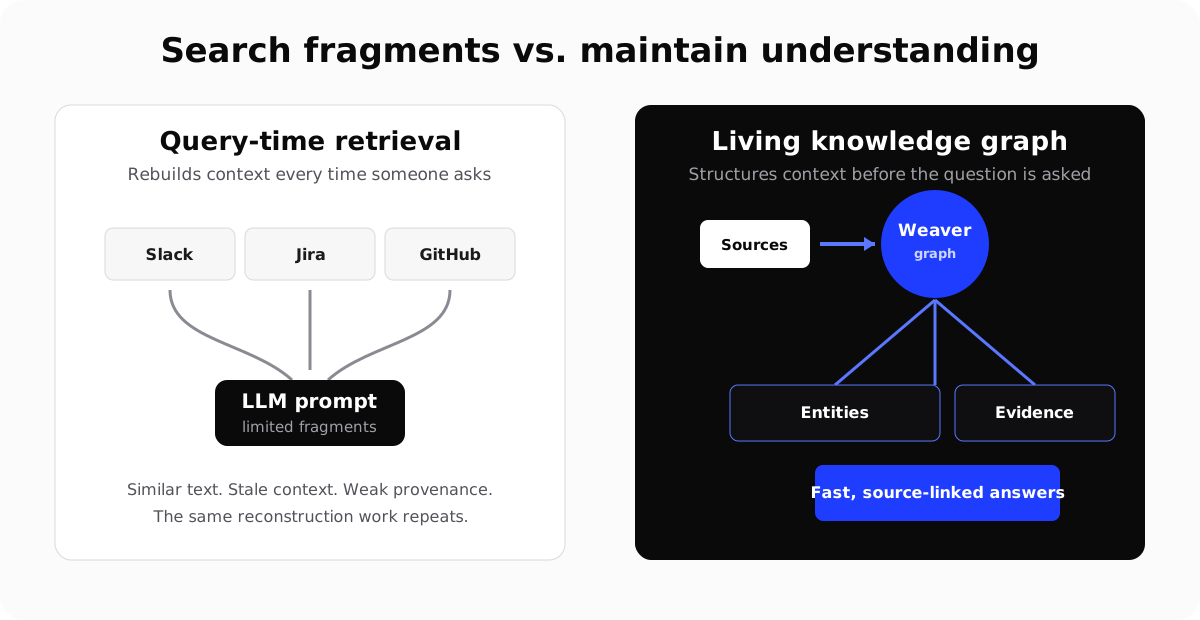
- Direct connections retrieve information well. A graph preserves the relationships needed to understand it.
- Precomputed context avoids rebuilding the same understanding from raw sources for every question.
- Shared entities, definitions, and evidence produce more consistent answers across employees and agents.
- Governance becomes possible when organizational context has a common home.
- MCP and a knowledge graph are complementary. MCP provides access to the graph as well as to the source systems.
Those benefits apply to every query. The larger effect shows up over time.
What compounds is judgment
Return to the two definitions of “active customer.” Once the company resolves that conflict, the answer should not live only in one employee’s chat history. A shared context layer retains the approved definition, its scope, its owner, the evidence behind it, and the decision it superseded. The next employee - or the next agent - inherits the company’s judgment instead of producing another guess.
If forty employees resolve the same conflict in separate chats, the company has paid for the same answer forty times and still has no shared record. If the first resolution is saved in shared context, the other thirty-nine employees can reuse it, along with every future employee and agent. The value comes from solving the question once instead of making everyone solve it again.
Some questions require a person to make a call. A leader may need to decide which metric definition applies or whether an exception created a new policy. A team may need to confirm whether two plans still conflict or whether one replaced the other. Source retrieval can expose these questions, but it cannot settle them. Once people do, the answer should become shared context.
Agents building the graph handle what inference can handle: resolving entities, connecting related work, and incorporating new sources as they appear. Human input goes where inference is not enough - approving a definition, resolving a conflict, explaining why one decision replaced another, or recording that a disagreement is still open.
The return is not limited to the person who made the improvement. Product, engineering, support, sales, and leadership all inherit it through the tools they already use. Context becomes a distributed company asset: maintained by activity across the organization, available to every authorized employee and agent.
The best AI users raise the floor for everyone
Direct MCP connections are remarkably effective in the hands of a power user. That person knows which sources matter, which terms are ambiguous, how to scope a question, and when an answer needs more evidence.
Most employees will not build and maintain that setup. They should not have to.
A shared context layer turns some of that expert behavior into infrastructure. It resolves known entities before a question is asked, retrieves related evidence across systems, respects company permissions, and separates current decisions from stale material. Instead of asking every employee to master context engineering, the company improves the context available to all of them.
This does not mean everyone gets an identical answer. An engineer, a product leader, and a support representative need different levels of detail and may have access to different information. They get role-relevant, permission-aware views built from the same governed foundation.
Lowering that barrier changes who can use AI effectively. Employees no longer need to remember every source, know the exact project name, or reconstruct the company’s history before doing useful work. They spend more time applying context and less time gathering it.
Bad context compounds too
The mechanism that makes shared context valuable also makes it dangerous.
An incorrect definition in one private AI session has a limited blast radius. An incorrect definition in a company-wide context layer reaches reports, decisions, and agent workflows across the organization. Stale information, weak inferences, and overly broad access spread just as efficiently as everything useful.
So a shared graph cannot simply declare one version of the truth. It needs the controls that earn trust:
- Evidence connecting every claim to its original source.
- Freshness signals that separate current information from history.
- Permissions that carry through every interface and agent.
- Clear ownership for important definitions and global guidance.
- A correction history showing what changed, when, and why.
- A way to preserve legitimate disagreement instead of collapsing it prematurely.
The goal is one shared foundation, not one mandated answer. A company should be able to settle a factual discrepancy once while still seeing where people hold different judgments or where the evidence is genuinely incomplete.
When direct connections are enough
Not every company needs a shared graph today.
An individual, a small team with strong shared knowledge, or a narrow workflow connected to one authoritative system may get everything it needs from direct MCP access. The setup is simple, the context is bounded, and the people involved can resolve ambiguity between themselves.
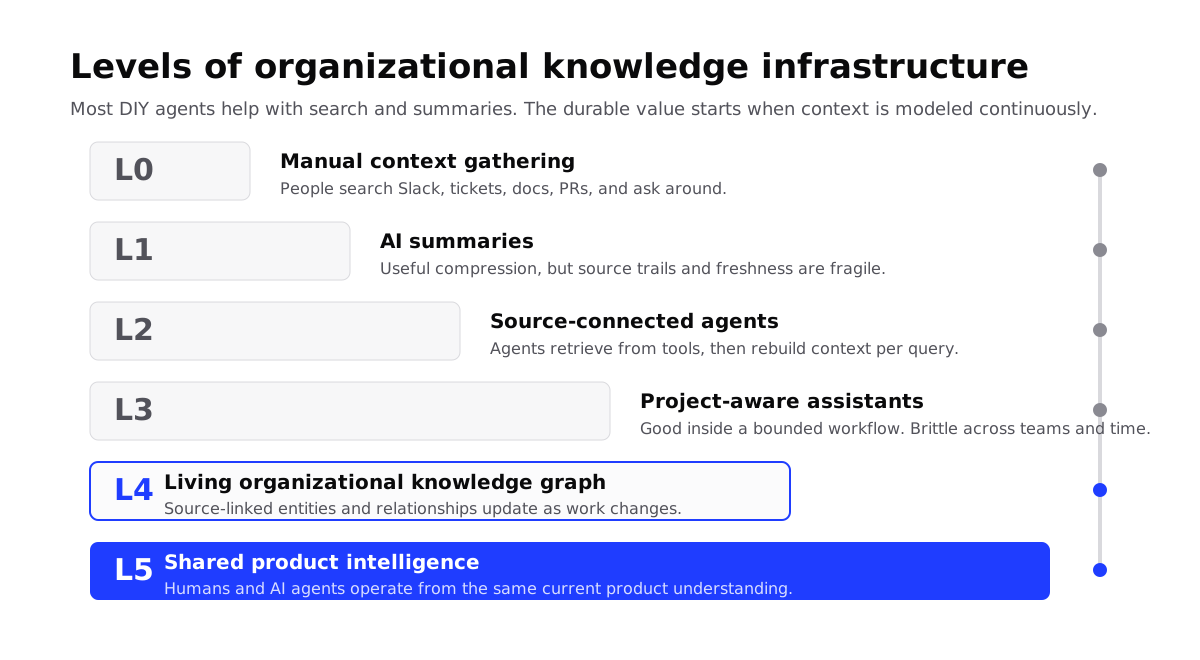
As AI adoption spreads, the company has more configurations to maintain and more agents interpreting the same sources independently. Shared context becomes worthwhile when that repeated work costs more than maintaining a common layer.
Make every improvement travel
MCP is becoming the standard way for AI to reach company systems, and companies should take advantage of it. The question is what happens after access.
If each employee rebuilds context privately, the company gets faster individuals. If resolutions and corrections are shared, later employees and agents benefit from work already done. That is how the company itself learns faster.