Why Companies Need a Knowledge Graph
Over the last year, a new question has started showing up in nearly every conversation about AI infrastructure:
If Claude, Codex, Gemini, and ChatGPT can connect directly to GitHub, Jira, Slack, Notion, Google Docs, and dozens of other systems, why would a company need a knowledge graph at all?
It’s a fair question.
Modern AI models are remarkably good at retrieving information. Give them access to the right tools and they can search tickets, review code, summarize conversations, and answer questions that would have required hours of investigation just a few years ago. MCP connections are one of the most important developments in software in years, and every company should be taking advantage of them.
But connecting AI to information and creating organizational intelligence are not the same thing.
As companies move beyond experimentation and begin relying on AI for everyday decisions, they are discovering that access to information is only the first layer of the problem. The harder challenge is creating a shared understanding of how the organization actually works. Most enterprise systems were designed to store information, not relationships. GitHub understands code. Jira understands tickets. Slack understands conversations. Notion understands documents. None of them were built to understand how those pieces fit together.
That distinction becomes important surprisingly quickly. Questions like “What changed this week?” or “Which pull requests were merged yesterday?” are fundamentally retrieval problems. The information already exists somewhere, and an AI assistant can usually find it.
The questions leaders care about, however, tend to look very different:
- Why is our largest initiative behind schedule?
- Which customer requests are influencing roadmap decisions?
- What projects are most at risk this quarter?
- Where are we repeatedly losing engineering time?
- What changed that leadership should pay attention to?
The answers rarely live inside a single system. They emerge from relationships spread across dozens of systems and hundreds of decisions.
A delayed project, for example, might involve roadmap decisions made months ago, a staffing change discussed in Slack, infrastructure work tracked in Jira, customer escalations captured in Salesforce, and implementation details hidden inside GitHub pull requests. No individual tool contains the full story. The answer exists in the connections between them.
Most direct-connection architectures handle this by reconstructing those connections every time a question is asked. The model searches Jira, then Slack, then GitHub, then meeting notes, then documents. It attempts to piece everything together, infer the relationships, and generate an answer.
A few minutes later, someone asks a related question, and the entire process begins again.
This approach works surprisingly well, particularly for teams that are early in their AI adoption journey. The challenge is that it doesn’t scale particularly well. As more employees, workflows, and agents rely on AI, organizations find themselves repeatedly paying the cost of rebuilding the same understanding.
A knowledge graph approaches the problem differently. Rather than reconstructing context every time a question is asked, it continuously processes information as it arrives. Customer requests become linked to roadmap decisions. Roadmap decisions become linked to specifications. Specifications become linked to tickets, code changes, launches, and outcomes.
The expensive work happens ahead of time.
When a question is asked, the organization is no longer starting from raw information. It is starting from accumulated understanding.
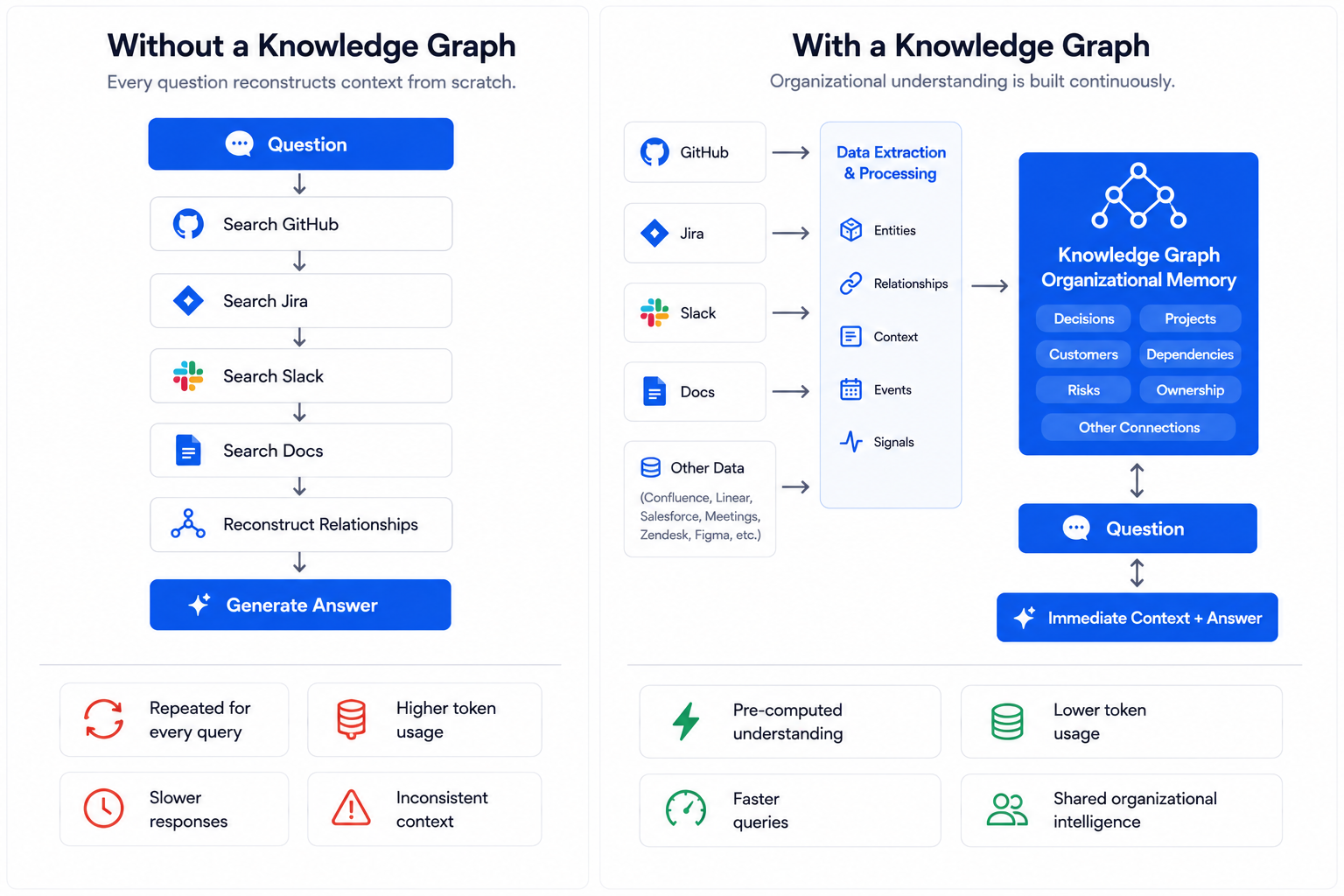
A useful way to think about the difference is to compare search with memory.
Imagine walking into a meeting with your most experienced product leader. Before speaking, they don’t reread six months of Slack conversations or reopen every Jira ticket. They already understand the company’s priorities, important customers, historical decisions, and current risks. Their value comes from accumulated context rather than raw access to information.
Knowledge graphs attempt to provide the same capability for AI systems. Instead of repeatedly discovering context, they continuously build and refine it.
This has a significant impact on both performance and cost. Most AI architectures repeatedly process the same information every time a question is asked. Every search across GitHub, Jira, Slack, documents, meeting notes, and customer feedback consumes tokens. Every attempt to reconstruct relationships consumes more. As organizations scale their use of AI, these costs compound quickly.
A knowledge graph shifts much of that work upstream. Relationships, dependencies, ownership, entities, and decisions are extracted continuously and stored as structured organizational knowledge. When a question arrives, the model works from pre-computed understanding rather than raw organizational data.
The result is typically:
- Fewer tokens consumed per query
- Faster response times
- Lower operating costs
- More consistent answers
- Less duplicated reasoning
Organizations are no longer paying to rediscover the same context thousands of times. They are paying once and reusing it everywhere.
There is another advantage that becomes increasingly important as AI adoption grows: governance.
Today, many organizations have dozens of teams experimenting with AI independently. Each team creates different prompts, connects different systems, and develops different assumptions about customers, projects, ownership, and priorities. Before long, the organization has multiple competing versions of reality.
One agent thinks “Customer Onboarding” refers to a roadmap initiative. Another thinks it refers to a support workflow. A third thinks it is a Jira epic. All of them are technically correct, but none of them are operating from a shared definition.
A knowledge graph provides a centralized layer for defining entities, ownership, permissions, terminology, dependencies, and organizational context. Instead of every AI system creating its own interpretation of the business, the organization creates a shared model once and makes it available everywhere. The graph becomes the system of understanding that sits above the systems of record.
Perhaps most importantly, it captures something most enterprise systems never do: intent.
GitHub knows what code changed. Jira knows which ticket closed. Slack knows what people discussed. Very few systems know why.
Questions such as the following are often among the most valuable:
- Why was this project prioritized?
- Why was another project canceled?
- Why did the roadmap change?
- Why was a customer request rejected?
- Did the implementation actually match the original intent?
Those answers are typically spread across months of conversations, meetings, documents, and decisions. A knowledge graph connects those signals into a continuous narrative. Not just what happened, but why it happened.
As AI accelerates software development, organizations are generating more code, more documents, more conversations, and more decisions than ever before. The bottleneck is no longer creating information. The bottleneck is understanding it.
Direct connections solve the access problem. Knowledge graphs solve the understanding problem.
The future likely requires both. Every organization will connect AI to its systems. That will become table stakes. The companies that move fastest, however, will be the ones that build a shared memory layer above those systems. A layer that continuously transforms fragmented information into organizational understanding.
Information is becoming abundant. Understanding remains scarce. That is why knowledge graphs matter.