Why Claude Code Isn't Enough for Your Company's Knowledge Graph
Claude Code, Codex, and Cursor have made individual engineers much faster. That naturally raises the next question: if these tools can write code, call APIs, and reason over files, why not have them connect to Slack, Jira, GitHub, Notion, and Google Drive, then build the company’s knowledge graph?
It sounds reasonable because the first demo is easy to imagine.
Coding agents are extraordinary execution tools. They can search files, call APIs, summarize documents, write code, and stitch together workflows. But an organizational knowledge graph is not a workflow. It is a continuously updated model of how your product, codebase, customers, projects, decisions, and teams relate to each other.
The hard part is not asking an LLM to search your tools.
The hard part is keeping that understanding correct as the organization changes.
The Prototype Looks Better Than the System
The early version is usually compelling.
Connect a few MCP servers. Add retrieval. Write prompts. Store summaries in a vector database. Ask questions like “what changed this week?” or “what is the status of the billing migration?” and the output looks useful.
But the demo is usually operating on a thin slice of reality: a few clean tools, a known project, a small amount of recent data, and a person in the loop who already knows what the answer should look like.
The real workspace is different. A roadmap item changes direction, but the old plan still exists in a doc. A Jira ticket says one thing, the PR implements another. A customer escalation explains why a feature matters, but that context never made it into the ticket. A design decision lives in a Slack thread. A delivery risk was discussed in a meeting, but the follow-up happened in GitHub.
The agent retrieves plausible fragments, but it does not know which ones are current, which ones conflict, which ones supersede others, or how they connect.
That is how you get answers that sound right and fail where it matters.
Where Tool-Connected Agents Break Down
The problem is not that the team lacks talent or that the model is weak. The problem is that company context has properties that simple retrieval systems do not model well.
Fragmentation. The context needed to answer one product question usually crosses many systems: code, tickets, PRs, docs, customer conversations, support threads, meetings, and chat. Each source has its own schema, permissions, naming conventions, and failure modes.
Staleness. Organizational knowledge decays immediately. Tickets close. PRs merge. Docs lag behind reality. Slack threads age into folklore. A summary that was correct last week can become actively misleading after one planning meeting or refactor.
Contradiction. Real organizations contain conflicting records. The plan says one thing, the implementation says another, and the customer-facing promise says a third. An agent that retrieves text has no durable model for deciding what supersedes what.
Relationship depth. The valuable questions are rarely single-hop. “Which customer complaints led to this roadmap item?” “Which PRs reduced the risk on that project?” “What work is blocked by this API change?” These are graph questions, not nearest-neighbor search questions.
Trust. Once an AI system confidently invents a connection, cites stale context, or misses the decision that matters, people start treating it as a suggestion box instead of shared infrastructure.
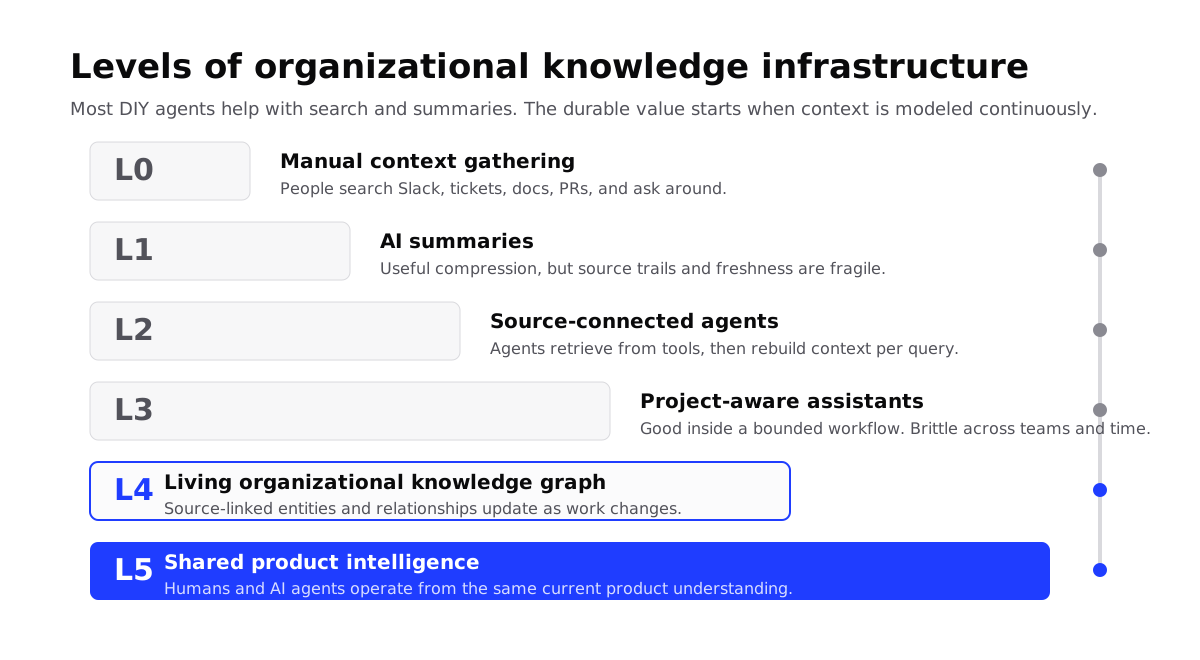
Most internal builds reach the first useful layers: AI summaries, source search, and maybe narrow assistants for a specific team or workflow. That can help. But it is not the same as a living, organization-wide product model.
The difficult step is moving from “an agent that can look things up” to “a system that knows how work, decisions, and product reality fit together.”
The Maintenance Problem
The first cost is implementation. The larger cost is keeping the system believable.
Every new integration adds another schema. Every team invents slightly different conventions. Every permission model has to be preserved. Every stale summary becomes a liability. Every source API change becomes your problem. Every model update requires revalidating behavior across an increasingly complex system.
And the people best equipped to maintain the system are your senior engineers and product leaders: the people who already carry the institutional knowledge you were trying to make accessible.
They become the maintenance layer.
Instead of applying their judgment to product and engineering decisions, they spend time debugging ingestion pipelines, fixing broken connectors, curating prompts, resolving entity mismatches, and explaining why the AI system got the answer wrong.
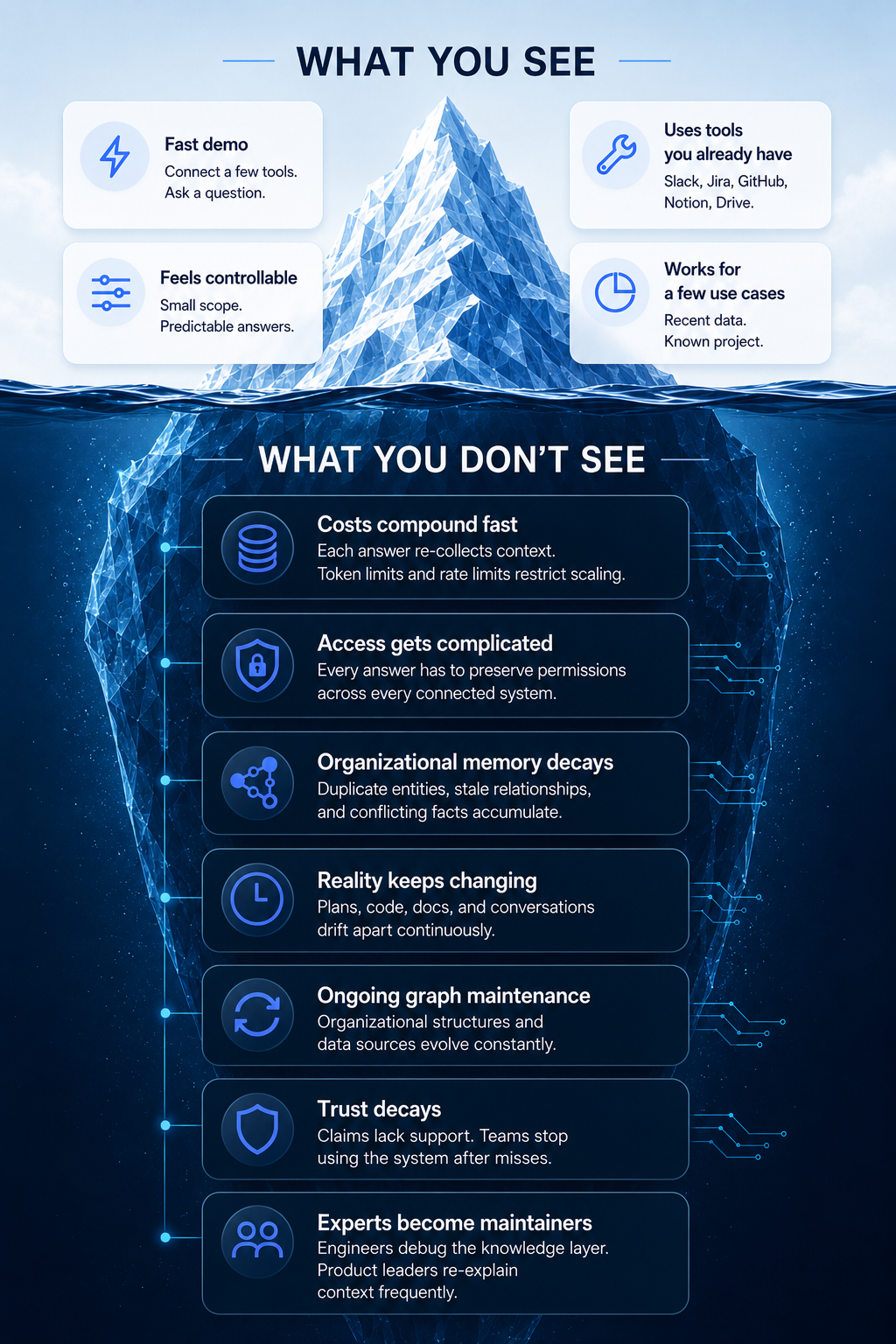
The project stops being a clever internal assistant and becomes a platform commitment.
What a Real Knowledge Graph Has to Represent
An organizational knowledge graph is not a chatbot over company tools. It is a structured operating model for product development.
It needs durable entities for the things your organization actually reasons about: products, features, projects, customers, teams, code areas, tickets, PRs, decisions, risks, feedback, and shipped changes.
It needs explicit relationships between those entities: caused by, implemented by, blocked by, superseded by, owned by, requested by, shipped in, at risk because of.
It needs time. What was true? What changed? What is still current? What was replaced? What is newly risky?
It needs provenance. Every claim has to point back to the source evidence that supports it. If the system says a project is at risk, it should be able to show the commits, tickets, comments, feedback, and decisions behind that judgment.
It needs permissions. A knowledge graph that leaks sensitive information cannot become trusted infrastructure. The graph has to preserve access boundaries while still letting people and agents benefit from broader organizational structure.
And it needs to update continuously, because product development never holds still long enough for a static map to stay true.
Why Retrieval Is Not Enough
Most DIY systems start with retrieval. That is understandable. Retrieval feels like the natural interface: ask a question, fetch relevant text, send it to the model.
But retrieval makes context a just-in-time activity. Each query asks the model to rebuild the organization’s memory from whatever fragments happen to fit into the prompt.
That is expensive, slow, and brittle.
For simple questions, it works. For product-context questions, it starts to collapse:
- It finds similar text, but misses causal relationships.
- It retrieves old context, but cannot reliably know it was superseded.
- It summarizes fragments, but loses the source trail.
- It answers confidently, but cannot distinguish fact from inference.
- It repeats the same reconstruction work every time someone asks a related question.
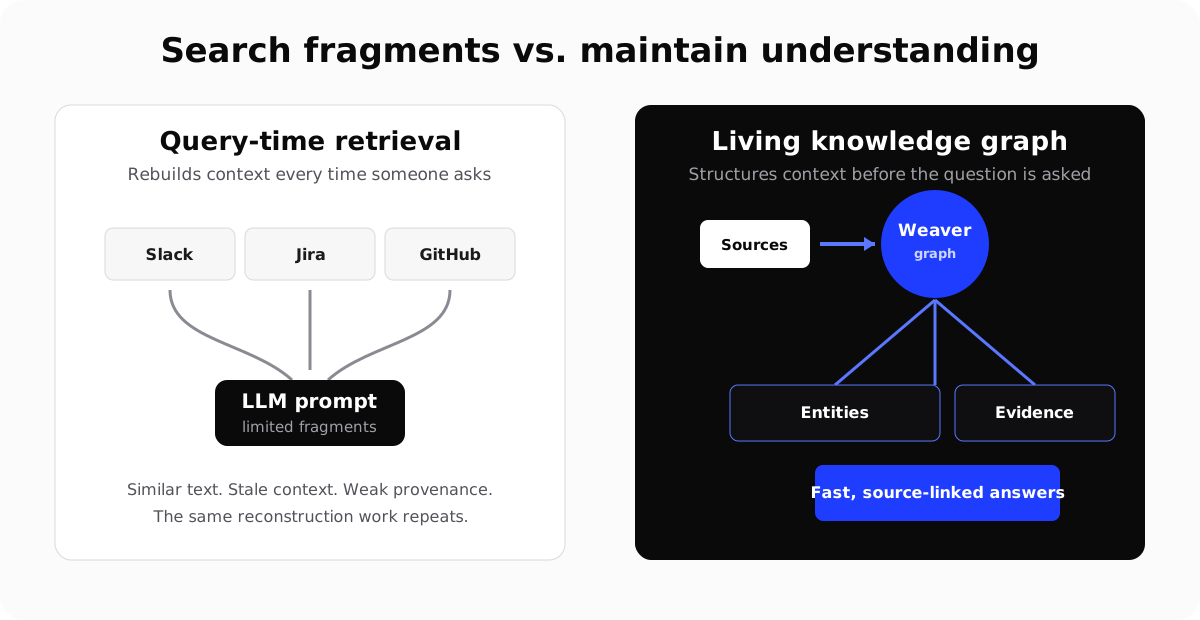
A knowledge graph changes the unit of context. Instead of treating every question as a fresh scavenger hunt across raw fragments, the system maintains structured, evidence-linked entities before the question is asked.
That is the difference between search and shared understanding.
What Has to Exist Underneath
Two capabilities make the difference between a useful prototype and a system teams can rely on.
A continuously maintained product model. The system needs a living representation of the product and the work around it: features, projects, code areas, dependencies, risks, customers, and decisions. It cannot be a static wiki, a pile of embeddings, or a one-time import. It has to update as code merges, tickets move, feedback arrives, and plans change.
Evidence-linked reasoning. The graph has to preserve the source trail behind every higher-level claim. A status update, risk, decision, or product insight should never be an unsupported model opinion. It should be a structured conclusion connected to the exact source material that supports it.
Around those two capabilities sits the rest of the platform work: source-specific ingestion, identity and permissions, entity resolution, temporal modeling, graph repair, model routing, cost control, evals, monitoring, and workflows that make the graph useful to humans and agents.
That is not something Claude Code should rebuild from scratch every time it answers a question.
Claude Code should be able to ask for context and receive it.
Where Devplan Fits
Devplan provides Connected Product Intelligence by connecting the systems product and engineering teams already use and maintaining a living, source-linked model of the organization’s product work.
Weaver, Devplan’s intelligence engine, continuously captures what changed, why it matters, where risks are emerging, and how work connects across code, tickets, docs, conversations, meeting notes, and customer feedback.
Product and engineering leaders can ask Devplan questions across the web, Slack, and MCP, receive Daily Digests, track projects automatically, and surface delivery risks. AI tools like Claude Code, Codex, Cursor, and other MCP-enabled agents can use the same organizational context instead of reconstructing it from scratch on every call.
The goal is not another chatbot over your tools.
The goal is shared understanding that compounds.
Coding agents make individuals faster. Connected Product Intelligence makes teams faster.