The Future of Product Management
AI made software development faster. It also broke the way we manage software teams.
Over the last several months, we spoke with product and engineering leaders across dozens of organizations to understand how AI is changing the way software gets built. The pattern was remarkably consistent. Teams are moving faster than ever, but the systems they use to stay aligned are struggling to keep up.
Tools like Claude, Cursor, and GitHub Copilot have dramatically compressed the time it takes to write and modify software. Engineers can explore more ideas, build more experiments, and deliver more functionality with the same amount of time.
But a new bottleneck has emerged.
The challenge is no longer how quickly we can write software. It is how quickly organizations can decide what to build, maintain shared understanding, and coordinate increasingly autonomous teams of humans and AI agents.
The future of product management will be defined by how well companies solve this new coordination problem.
The Product Operating Model Was Built for a Slower World
For the last two decades, most product organizations were designed around a simple constraint: engineering capacity was scarce.
The industry responded by building systems to manage that scarcity. We created backlogs, story points, sprint ceremonies, detailed project plans, status meetings, and increasingly sophisticated layers of product operations and program management.
These systems were not mistakes. Agile fundamentally improved how software teams operated. Product management became a critical discipline because someone needed to translate customer needs into clear priorities, align stakeholders, and help engineering teams make good decisions.
But many of the operational practices that grew around Agile were designed for a world where software development moved much slower.
When engineers can implement meaningful changes in hours instead of weeks, asking teams to spend countless hours maintaining tickets, updating status documents, and manually transferring information between systems starts to become inefficient.
Our research showed this clearly. Cross-team visibility was one of the most universal pain points we heard. Leaders told us they were drowning in information spread across Jira, Linear, GitHub, Slack, customer conversations, documents, and meeting notes.
The problem is not a lack of information.
The problem is that organizations have no reliable way to transform all of that information into a shared understanding of what is happening.
The Future Head of Product Becomes the Orchestrator of Intent
Many people assume AI will reduce the importance of product management.
We believe the opposite will happen.
The best product leaders have never created value by maintaining a backlog or chasing status updates. They create value by deeply understanding customers, defining the right outcomes, making difficult prioritization decisions, and aligning the company around a shared vision.
Yet today, many Heads of Product spend a substantial portion of their time acting as the organization’s coordination layer.
They gather updates from engineering teams. They prepare leadership reviews. They reconcile conflicting information between systems. They explain why decisions were made months ago. They spend time finding information that already exists somewhere inside the company.
This is not the highest and best use of product leadership.
The future Head of Product will become an orchestrator of intent.
Their job will be to clearly communicate where the organization is going, what customer problems are worth solving, what outcomes matter most, and what tradeoffs teams should make.
The operational burden of keeping everyone aligned will increasingly be handled by systems that continuously understand what is changing across the organization.
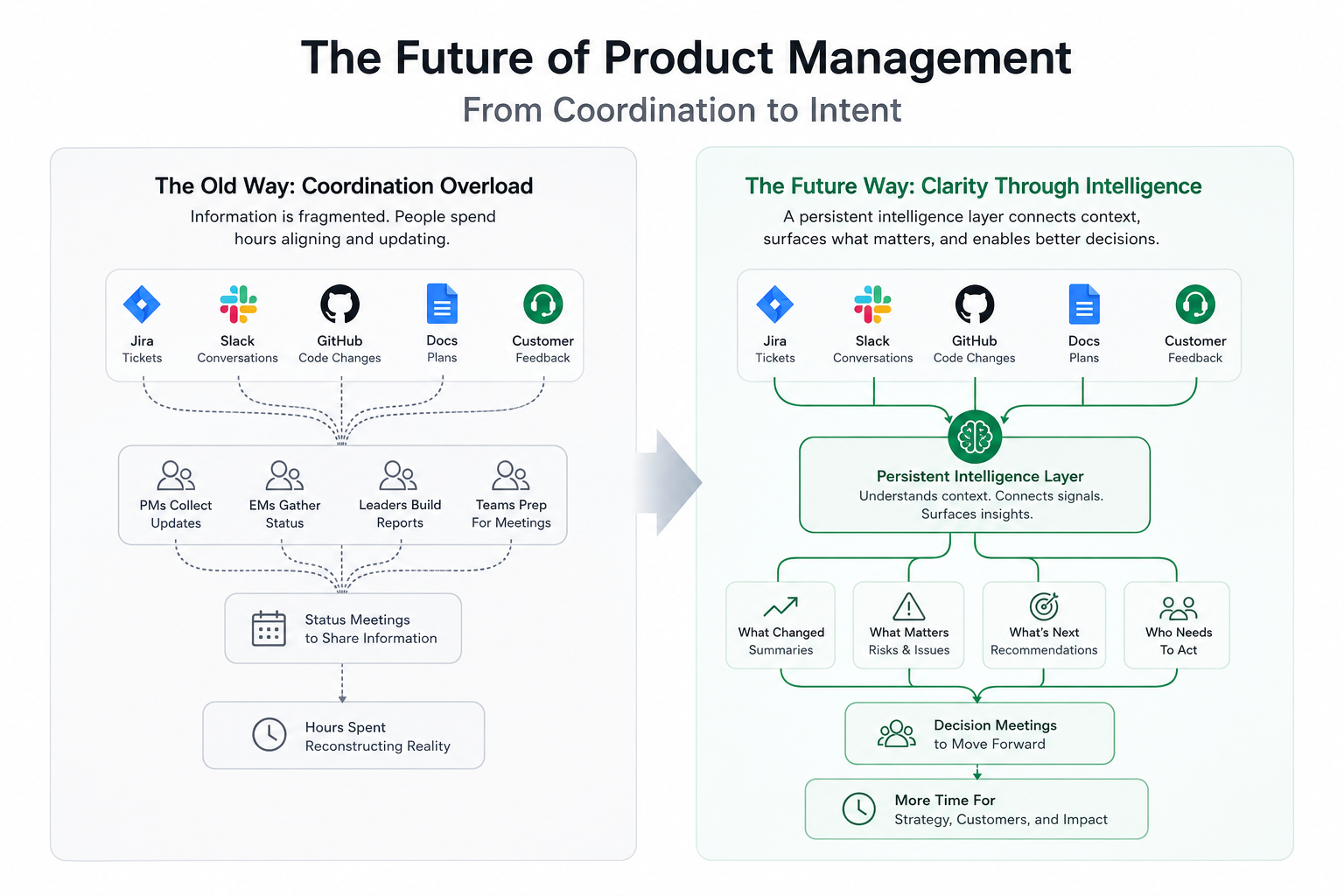
Status Meetings Will Become Decision Meetings
One of the most surprising things about modern product organizations is how much time highly skilled people spend exchanging information that already exists.
Engineers summarize what they built. Product managers collect updates. Leaders assemble reports. Teams sit in meetings to explain what happened during the previous week.
This process exists because information is fragmented.
A code repository knows what changed in the product. Customer calls reveal what users are struggling with. Product documents explain intended outcomes. Slack conversations contain decisions and tradeoffs. Tickets represent planned work.
The challenge is that none of these systems understand each other.
The future product organization will not eliminate meetings. Human conversations remain essential for creativity, debate, strategy, and difficult decisions.
But the purpose of meetings will change.
Instead of asking, “What happened?” leaders will ask, “What should we do next?”
The Most Important Product System Will Not Be the Backlog
For years, the backlog has been the center of software execution.
That made sense when humans needed to manually translate ideas into requirements, requirements into tickets, and tickets into completed work.
The future will look different.
Tickets will increasingly become temporary execution artifacts generated and maintained by AI. They will not be the permanent record of why a company made a decision or how a product evolved.
The true source of knowledge will be a continuous understanding of intent and reality.
Intent includes customer problems, company strategy, goals, priorities, and desired outcomes.
Reality includes customer feedback, design decisions, technical constraints, code changes, project progress, and emerging risks.
The companies that can continuously connect these two worlds will move dramatically faster than those still relying on humans to manually maintain their systems of record.
AI Agents Need the Same Context as Humans
Much of the conversation around AI focuses on capability.
Can an AI agent write code? Can it create documentation? Can it analyze customer feedback?
Those questions are important, but they miss the bigger challenge.
A great engineer is valuable not because they know how to write syntax. They are valuable because they understand context. They know why a feature exists, what previous decisions were made, what tradeoffs matter, and how their work affects the broader product.
AI agents require that same understanding.
The future product organization will include humans and AI agents working from the same organizational memory. Both will need access to customer insights, technical history, strategic priorities, decisions, and current progress.
The companies that solve this will unlock a level of leverage that is difficult to imagine with today’s operating models.
Smaller Teams, Greater Leverage
The software organizations of the future will likely look very different from those of today.
They will be smaller. They will be composed of more experienced product leaders, engineers, and designers. They will have fewer layers of management whose primary responsibility is coordinating information between groups.
This does not mean leadership becomes less important.
It means leadership becomes more valuable.
The best organizations will be built around a smaller number of highly capable people working alongside increasingly sophisticated AI agents. Their advantage will not come from having the largest teams. It will come from having the clearest intent and the fastest path from decision to execution.
The Future of Product Management Has Already Started
This transition will happen faster than most companies expect.
The biggest mistake organizations will make is treating AI as a productivity upgrade while preserving the same meetings, reporting structures, and coordination processes that existed before AI.
Giving every engineer a powerful coding assistant does not make a company AI-native.
It makes a traditional company slightly faster.
The companies that win over the next decade will rethink how product development works when software creation is abundant, organizational knowledge can be continuously understood, and AI agents become active participants in the development process.
For product leaders, this should be exciting.
For decades, some of the best minds in software have spent enormous amounts of energy managing the friction required to keep large organizations aligned. Status updates, manual documentation, searching for historical decisions, and maintaining systems became accepted as the cost of building complex products.
That cost is beginning to disappear.
The future of product management is not the elimination of product leaders. It is the elimination of everything that prevented them from doing their best work.
The product leaders who embrace this shift will have more leverage than any generation before them. They will spend less time managing coordination and more time understanding customers, defining strategy, making decisions, and creating clarity.
The future belongs to organizations that make that transition first.